


3+ Ways to distinguish real and fake 304 stainless steel with 100% accuracy
304 stainless steel is a popular material due to its high durability and excellent corrosion resistance. However, today there are many counterfeit products or those mixed with low-quality components. This article by Son Ha SSP will summarize the methods for testing 304 stainless steel, along with the pros and cons of each method, to help you reliably distinguish between real and fake 304 stainless steel.
1. How to distinguish real and fake 304 stainless steel: Using a magnet to test magnetism
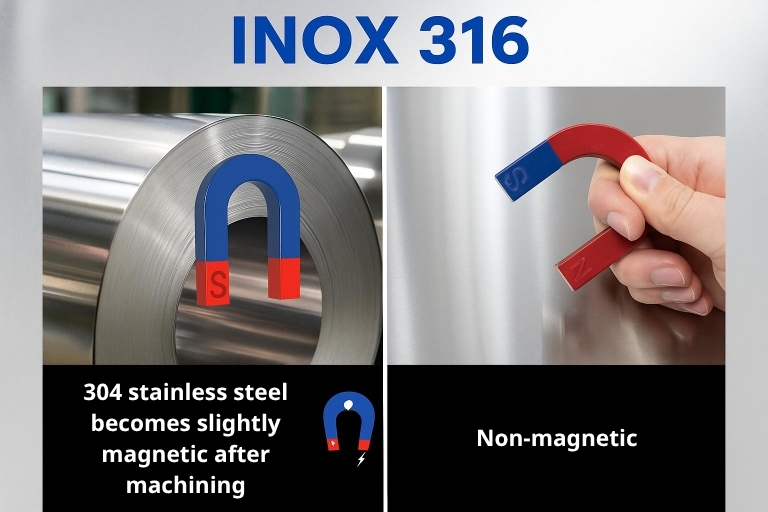
The first method to identify real versus fake 304 stainless steel is by using a magnet. 304 stainless steel belongs to the Austenitic stainless steel group, containing about 18–20% Cr and 8–10% Ni, meaning it is non-magnetic. When placing a magnet near it, genuine 304 stainless steel will exhibit almost no magnetic attraction. In contrast, other types of stainless steel, such as 201 or 430, will strongly attract the magnet. Therefore, this initial step of using a magnet can help rule out metals with strong magnetic properties.
How to distinguish real and fake 304 stainless steel using a magnet
Instructions: Use a magnet (such as a small magnet or a fridge magnet) and place it directly against the surface of the stainless steel material you want to test. Observe the magnetic pull: if there is no attraction or it is very weak, it is highly likely to be genuine 304 stainless steel. If it attracts strongly, it could be 201 or 430 stainless steel, or another lower-quality type.
Using a magnet is a simple method but is only suitable for a quick initial check; it cannot definitively confirm whether the material is actually 304 stainless steel. Normally, genuine 304 stainless steel will have little to no magnetic pull. However, after machining processes such as bending, welding, or cold stamping, the material can become slightly magnetic, resulting in a weak magnetic attraction. Conversely, some high-quality 201 stainless steels may also exhibit very little magnetic attraction, making magnet-based identification prone to confusion.
2. Using specialized stainless steel testing reagents
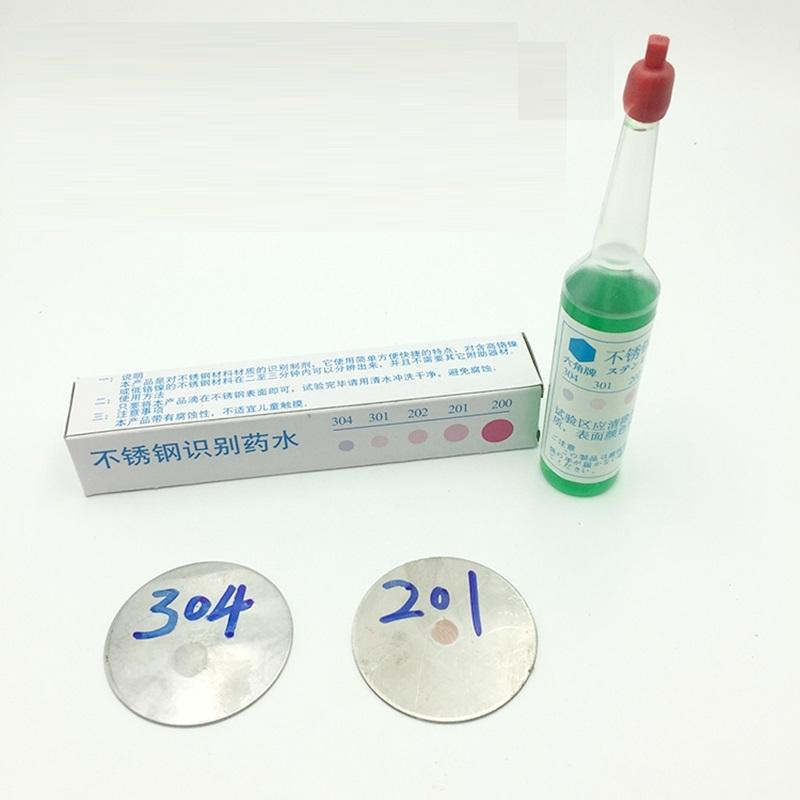
The second method to distinguish real and fake 304 stainless steel is by using a specialized stainless steel testing reagent (or testing fluid). This usually involves nitric acid or special reactive agents that change color depending on the composition of the stainless steel. Due to localized oxidation reactions, different types of stainless steel with varying Chromium and Nickel contents will produce different colors after a drop of the reagent is applied. Specialized reagents can usually accurately differentiate between 201, 304, and 316 stainless steels based on the color that appears within a few seconds to a few minutes.
Using specialized stainless steel testing reagents to distinguish genuine from fake 304 stainless steel
Here is the translation of your text into English:
Instructions:
-
Preparation: Clean the stainless steel surface to be tested with a clean cloth. If the material is plated or coated, scrape off the coating so the reagent can make contact with the bare steel.
-
Applying the reagent: Use a dropper (usually included with the reagent bottle) to apply a single drop of the solution onto the test area.
-
Observation: After about 5–180 seconds, the color will change. Compare it with the color guide on the reagent label. For example, according to manufacturers: 304 stainless steel will not change color or will turn light blue within 3 minutes, whereas 201 stainless steel will turn brick red within 50 seconds, 202 stainless steel will turn red after ~1 minute, and 301 stainless steel will turn light red after 2–3 minutes.
-
Post-test cleanup: Use a wet cloth to wipe the solution clean to prevent staining or surface corrosion.
This method has a very high accuracy rate if the correct reagent is used for the stainless steel being tested. However, it requires careful handling: wear gloves and safety glasses, and avoid getting the drops on your skin or in your eyes. Additionally, the reagent may cause minor damage to the stainless steel surface.
3. How to distinguish real and fake 304 stainless steel: Visual inspection of the surface and brightness
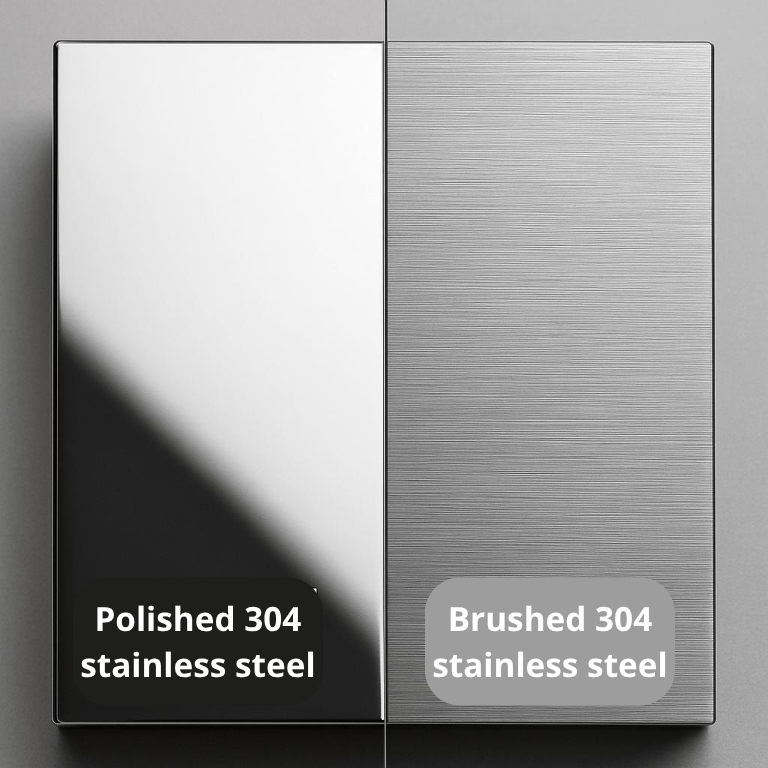
Principle: 304 stainless steel has a high Nickel content, which enhances its rust resistance and gives it a characteristic smooth, shiny, and non-yellowing appearance. In contrast, lower-quality stainless steel is often duller and may sometimes turn yellow or develop red rust spots after a short period of use. Therefore, a basic visual inspection is also a helpful way to identify it.
The surface of 304 stainless steel
Instructions:
-
Carefully inspect the product’s surface: Genuine 304 stainless steel usually feels smooth and has a high, mirror-like brightness. The silver color is bright and even throughout.
-
Observe cut edges and welds: The welds of standard 304 stainless steel will be flat, uniform, and free of excessive burrs, unevenness, or small rust spots.
-
Check the color: 201 stainless steel often has a slight yellow tint due to its lower Nickel content. If you notice the stainless steel surface turning slightly yellow or brown (like rust, but not red rust), it may not be 304.
However, this inspection method only provides a relative level of accuracy as it relies on visual perception and experience. Therefore, this method should be combined with other tests to confidently confirm whether it is truly 304 stainless steel.
4. Spark testing by grinding
When grinding or cutting steel with a grinder or cutting machine, the iron alloy emits sparks of varying colors, lengths, and densities. Because 304 stainless steel has a low Carbon and high Nickel content, when ground, it will produce fewer sparks, which are light yellow in color, and the spark density will be sparser. In contrast, other types of stainless steel (201, 430, or carbon steel) produce more sparks that are dark yellow and brighter due to their higher iron/sulfur content. Therefore, observing sparks is a common industrial method for differentiation.
Instructions:
-
Use an angle grinder or a hand-held cutter fitted with a steel grinding disc. Gently grind a small corner or surface of the sample stainless steel bar.
-
Observe the emitted sparks: Take note of the quantity and color. 304 stainless steel usually produces few sparks that are light yellow or slightly bright, and the spark stream (density) is very thin. If there are many dark yellow sparks (similar to carbon metals), the material is not 304.
The method of observing sparks during grinding is only suitable in workshops or places with the proper equipment. It requires someone familiar with metal spark colors to distinguish accurately. The accuracy is moderate, and it is usually used as a reference check.
As you can see, the methods to distinguish real and fake 304 stainless steel all have their own pros and cons. However, to reliably identify genuine vs. counterfeit 304 stainless steel, users should combine multiple methods rather than relying on a single indicator. Ultimately, choosing products from reputable brands with clear quality certifications and origins remains the safest solution to ensure the durability, rust resistance, and long-term effectiveness of your 304 stainless steel.
>RELATED ARTICLES:
Which Is Better: 304 or 430 Stainless Steel? Which One Should You Choose?
How to Distinguish Between 201 and 304 Stainless Steel: 5 Accurate Identification Tips
Stainless steel export factories in Vietnam: Production capacity & trusted global partnerships
Next latest post

THƯƠNG HIỆU QUỐC GIA VIỆT NAM 2026 VINH DANH 5 SẢN PHẨM SƠN HÀ
Looking back on SONHA SSP’s journey at highly-functional Material Week Tokyo 2026
Detailed decorative stainless steel pipe size chart 2026