

What Is a Hot Rolled Coil? Characteristics, Applications, and Classification
Hot Rolled Coil (HRC) is a type of steel produced by heating iron and other alloying elements to very high temperatures, then rolling it into coil form. This process creates a steel product with high strength, making it suitable for structural and heavy mechanical applications. To better understand hot rolled coil steel, the article below by Sơn Hà SSP will clarify its definition, characteristics, and the most common types available today.
1. What Is a Hot Rolled Coil?
Hot Rolled Coil (HRC) is a material manufactured by heating iron and other alloying elements to high temperatures, then rolling it into coil form. The rolling temperature typically exceeds 900°C, which is high enough to make the steel ductile and easy to shape. After rolling, the steel is wound into large coils for easier transportation and storage.
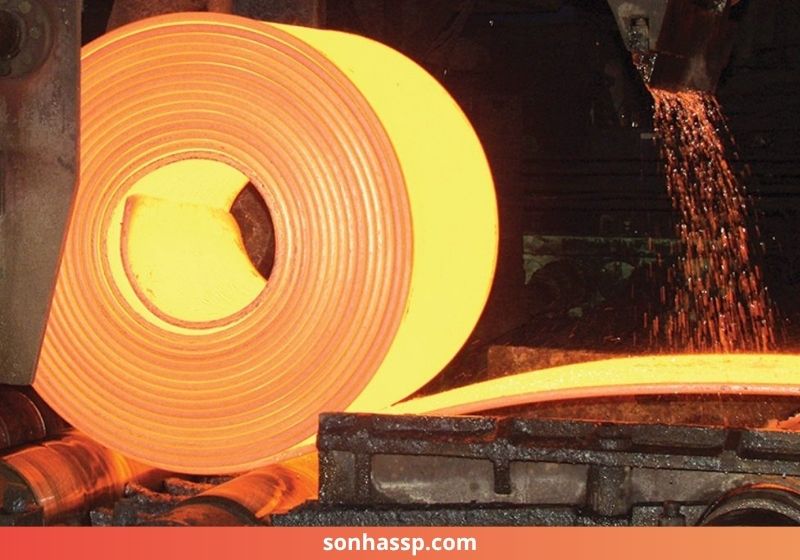
Hot rolled coil steel
The hot rolling process enables steel to achieve the following characteristics:
- Rough surface: Unlike cold-rolled steel, hot rolled steel does not have a smooth or polished finish. Its typical color ranges from bluish-black to grayish-blue, formed by the iron oxide layer that appears during natural cooling after rolling.
- High mechanical strength: It offers excellent load-bearing capacity and impact resistance, with low risk of cracking during bending, cutting, or welding. This is why hot rolled coil is preferred for heavy load-bearing structures.
- Easy fabrication: It can be welded, cut, bent, and stamped without requiring complex heat treatment. In addition, hot rolled coil serves as raw material for producing other steel products such as cold-rolled steel, galvanized steel, steel pipes, and hollow sections.
- Cost-effective: It helps optimize costs for large-scale projects.
2. Common Types of Hot Rolled Coil
Hot rolled coil is classified into various types based on chemical composition and mechanical properties. Among them, three main groups are widely used:
2.1. Commercial Hot Rolled Coil
This type is low- or medium-carbon steel, primarily composed of iron (Fe) with a small amount of carbon (C < 0.25%). Typical examples include structural steel grades such as SS400 (Japanese JIS standard) and Q235 (Chinese GB/T standard).
Commercial hot rolled carbon steel usually has a rough surface, a characteristic bluish-black color, and high strength. Thanks to the high-temperature rolling process, this type of steel is easy to bend, weld, cut, and machine. It is commonly used as raw material for basic load-bearing structures such as beams and columns in construction, as well as simple mechanical components.
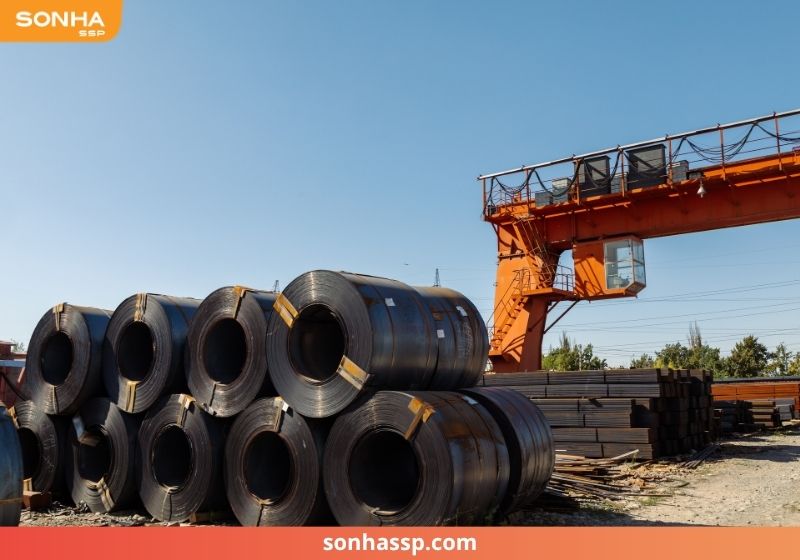
Images of Hot Rolled Coil Production
2.2. Stainless Hot Rolled Coil
This type of alloy steel contains corrosion-resistant elements such as chromium (Cr) and nickel (Ni), with the addition of molybdenum (Mo) and manganese (Mn). Thanks to these alloying components, stainless steel offers excellent corrosion resistance and a bright surface finish.
Stainless hot rolled coil is commonly used in environments that require high corrosion resistance and aesthetic appeal, such as chemical storage tanks and pipelines, laboratory and medical equipment, as well as stainless steel components in kitchens and bathrooms. However, the price of stainless steel coils is generally higher due to the cost of alloying elements.
2.3. Alloy Hot Rolled Coil
Alloy hot rolled coil is produced by combining hot rolled steel with alloying elements such as chromium, nickel, and molybdenum. With increased alloy content, alloy hot rolled steel exhibits enhanced mechanical properties, including high strength and excellent pressure resistance.
Typical applications include heavy load-bearing structures such as bridges, highways, and infrastructure projects; aerospace components (aircraft structural parts); and the oil and gas industry (offshore platforms and high-pressure pipelines).
3. Common Applications of Hot Rolled Coil
Hot rolled coil is widely used in various industrial and construction sectors due to its high strength and ease of fabrication. Key applications include:
- Construction industry: Hot rolled coil is used to manufacture structural components such as beams, columns, factory frames, scaffolding, and bridge decks. Load-bearing elements in industrial and civil projects often utilize this steel due to its strong load capacity.
- Mechanical engineering:It serves as raw material for machinery and mechanical components. Many parts in the production of industrial machinery, agricultural equipment, and manufacturing equipment are made from hot rolled coil because of its weldability and durability.
- Automotive industry: Hot rolled coil is used to produce chassis frames, vehicle bodies, and load-bearing components. Thanks to its impact resistance and formability, it is suitable for car frames, truck bodies, and large automotive parts.
- Shipbuilding: It is used in manufacturing ship hulls, marine structures, and load-bearing components on vessels. The high strength of hot rolled steel helps ship hulls and structural beams withstand wave and water pressure effectively.
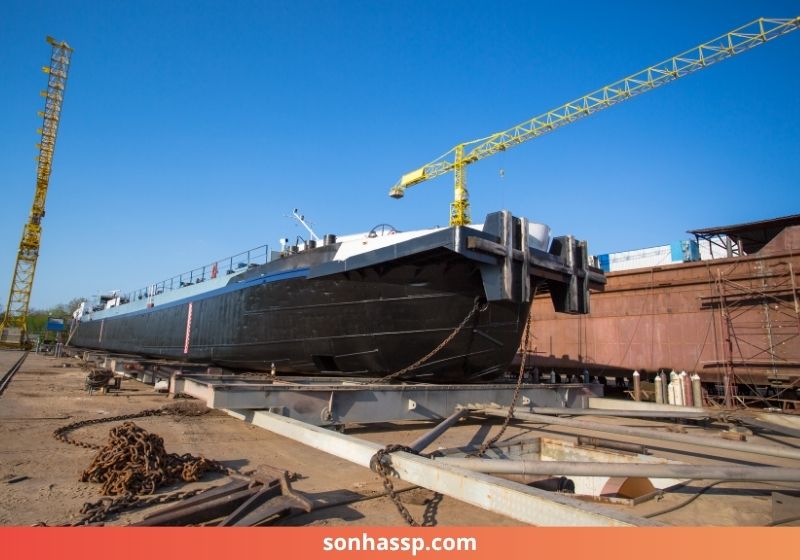
Hot rolled coil is used in the shipbuilding industry
- Steel Pipes and Pre-Engineered Building Structures: Hot rolled coil is the primary raw material for manufacturing black steel pipes, hollow sections, and welded steel pipes. It is also used for structural frames of pre-engineered steel buildings and containers. For example, in the oil and gas industry, hot rolled coil is used to produce oil and gas pipelines as well as pressure vessels.
- Other Applications: In addition, hot rolled steel is used to manufacture railings, utility poles, railway tracks, roofing sheets, construction equipment (such as excavators and bulldozers), and various consumer products that require high mechanical strength.
With its flexibility and relatively low production cost, hot rolled coil has become the “backbone” material in many engineering works, construction projects, and heavy industrial manufacturing.
4. Difference Between Hot Rolled Coil and Cold Rolled Coil
Cold rolled coil is a steel product that is re-rolled from hot rolled steel at room temperature, followed by annealing and surface polishing processes. This process produces steel with a smooth, bright surface, uniform thickness (typically ranging from 0.15 mm to 4 mm), and high hardness and strength.
Although both are steel coils, hot rolled and cold rolled steel have many important differences. Below is a comparison table distinguishing hot rolled coil from cold rolled coil.
| CRITERIA | HOT-ROLLED STEEL COILS | COLD-ROLLED STEEL COILS |
| Production process | Rolling at high temperatures (above 900°C), higher than the recrystallization temperature of steel. | Further rolling from hot-rolled steel at room temperature. |
| Shape | Large coil form, easy to further process | Thin coil form, high precision |
| Surface | Rough, rough, with an oxide layer | Smooth, glossy |
| Color | Dark blue or gray-blue | Light gray or silver-white |
| Common thicknesses | From approximately 1.2 mm to over 12 mm | From approximately 0.15 mm to 2 mm |
| Dimensional tolerance | Larger, lower accuracy | Smaller, higher accuracy |
| Edge | Rounded, not sharp | Straight, sharp, clean edge |
| Mechanical properties | Good strength, ductile, easy to weld and bend | Harder, higher tensile strength |
| Machinability | Easy to cut, weld, bend, and stamp | Suitable for precision stamping and fine shaping |
| Corrosion resistance | Low, easily oxidizes if the surface is not treated | Better due to the smooth surface |
| Price | Lower | Higher |
| Main applications | Building structures, steel frame structures, shipbuilding, heavy machinery | Galvanized steel sheet production, household appliances, automobiles, precision engineering |
Overall, hot rolled coil is suitable for applications that require heavy load-bearing structures and do not demand strict aesthetic standards. In contrast, cold rolled coil is used for products that require high precision, smooth surface finishes, and minimal deformation.
Conclusion
With outstanding characteristics such as high mechanical strength, flexible fabrication capability, and cost efficiency, hot rolled coil has become an indispensable material across various industries. Understanding the concept, classification, and applications of hot rolled coil—along with clearly distinguishing it from cold rolled coil—enables engineers and businesses to make effective material selection decisions, ensuring project quality while optimizing budgets.
Through this article, SonHa SSP Vietnam hopes to have answered the question “What is hot rolled coil?” as well as highlighting its common applications and key differences from cold rolled coil, helping engineers and enterprises choose the most suitable materials for their needs.
>RELATED ARTICLES:
What Is a Ø16 Stainless Steel Pipe? Specifications, Classification, and the Latest Price List
Son Ha SSP Is Honored to Receive the BIS Certification (India)
Decorative Ø40 Stainless Steel Pipe (DN40) – Comprehensive Information from A to Z
How Rigorous is the Production Process of Son Ha SSP Stainless Steel Pipes?
Next latest post
What Is a Steel Grade? Current Steel Grade Standards
[Q&A] What Is Stainless Steel? Why Is It Called Stainless Steel?
Safe Stainless Steel Pipe Transportation Process and Important Considerations